Index

2.22.2018

Work, Play, and the (Oculus) Rift that Divides


I currently have three ongoing projects:


Creating toolpaths in PixelCNC using its own logo as image input.

PixelCNC:

My most recent endeavor, PixelCNC, was started at the end of summer 2017. It has since been released in an alpha early-access state, with a few big items left on the todo list in order to get it where I really want it to be.

PixelCNC relies on image-based operations to generate CNC toolpaths from image input. A near-infinite speedup in toolpath generation could be had by moving the image processing code to GPU. With my expertise and nearly 20 years of experience with OpenGL this is not too much of a hurdle to overcome, at least as far as planning it out and solving the problem itself. The most difficult aspect is making the commitment to spending the time mentally exerting myself.

A larger and less clear goal would shift PixelCNC toward the realm of image editing and manipulation - where adding the ability to create and edit images as a whole new program mode would further remove the necessary step of using a separate dedicated program specifically for creating an image to feed into PixelCNC. The need for dealing with an image manipulation program could be reduced and/or eliminated, further streamlining the workflow for artistic CNC endeavors. That is, after all, the entire point of PixelCNC. I have a few ideas concerning what an image editing mode would comprise, including some things never before seen in an image editing program that lend themselves really well to sculpting depthmaps easily and intuitively - and would build on the existing image processing functionality I've already written.

One more decently sized feature I'd like to add is an auto-update system, which would be introduced once PixelCNC enters beta, and would free up users' time so that they no longer need to manually download and install updated versions of PixelCNC as they are released.

There's a bunch of other little things on the todo list for PixelCNC that aren't exactly along the path, and just require the time and effort. These comprise less consequential but still useful or handy things. A few to give you an idea are:

  • Functionality to detect when a series of toolpath segments fit a circular arc within a given threshold and replace them with G03/G04 circular arc motions.
  • User-defined presets for CNC operations, so users can quickly create an operation they use frequently without having to edit each parameter and rebuild operations from scratch.
  • Defining rectangular/cylindrical stock shapes for confining generated toolpaths to. This is trickier than it sounds, simply because of how PixelCNC works.
  • Inlay generation mode, which would build on the existing medial-axis carving operation to allow the creation of a negative carving - whatever operations that would entail - to perfectly fit over an existing medial-axis carve operation.
  • Automatic G-code export by tool, which would build on the existing ability to toggle which operations are included in exported G-code, so that users could easily create CNC programs which will perform all operations concerning each tool individually.
  • Polygon Operation: similar to the spiral operation, except the spiral would be an N-sided polygon so that toolpaths could be concentric triangles, squares, hexagons, and so on.
  • Mesh export: allowing users to export the heightfield meshes that PixelCNC generates for visualization and certain CAM algorithms.

Another thing that I'm planning and setting up for is recording a sort of demonstration video for PixelCNC, which shows the entire process going from an image to creating a project in PixelCNC, defining tools, setting operations, using the simulation mode, exporting the G-code, loading it up into a CNC controller, and actually cutting stuff. This could also be cut down into a short and concise promotional video to serve as something the public could pass around to share the fact of PixelCNC's existence to efficiently and effectively get the idea across. I'm still deciding what exactly I want to actually demonstrate, because running the CNC is always a bit of an energy, time, and raw material commitment so I want to be sure of what I decide to do before I go ahead with the requisite expenditures.


Holocraft:

A less recent but related project, Holocraft, which is a much more esoteric CNC related pursuit consists of a program that is in a less user-friendly state of partial disrepair. I could fix it up a bit, and begin selling it as well, which was at a time the tentative plan. The real plan was to sell actual holograms, but the lack of access to a CNC capable enough of realizing that vision put a relative end to that for the time being. An old friend I recently got in touch with disclosed the fact that he's been working to set up a hacker space which possesses machines that could make my original dream a reality.


Another idea with Holocraft is to incorporate it into PixelCNC instead, as an operation the user would generate a toolpath for on a loaded image. The trick there is that Holocraft specifically relies on 3D geometry input which it then generates toolpaths for forming reflective optics that will recreate some representation of that geometry when viewed under a point light source.

Decisions, decisions..


Bitphoria:

My biggest project, at least that I've invested the most time and energy into over recent years, is my game/engine Bitphoria. It's the culmination of a lifetime of learning all-things-gamedev, and virtually every novel game idea I've ever had. I take pride in the fact that it's written from scratch, and does things differently, but it's not quite "there" insofar as the visual polish and aesthetic are concerned. The actual 'game' aspect itself is largely incomplete, but it is basically ready to be made into a wide array of games. However, due to recent developments I've begun tinkering around with Bitphoria again, inbetween incremental PixelCNC updates, with a newfound vision for what it is meant to be.
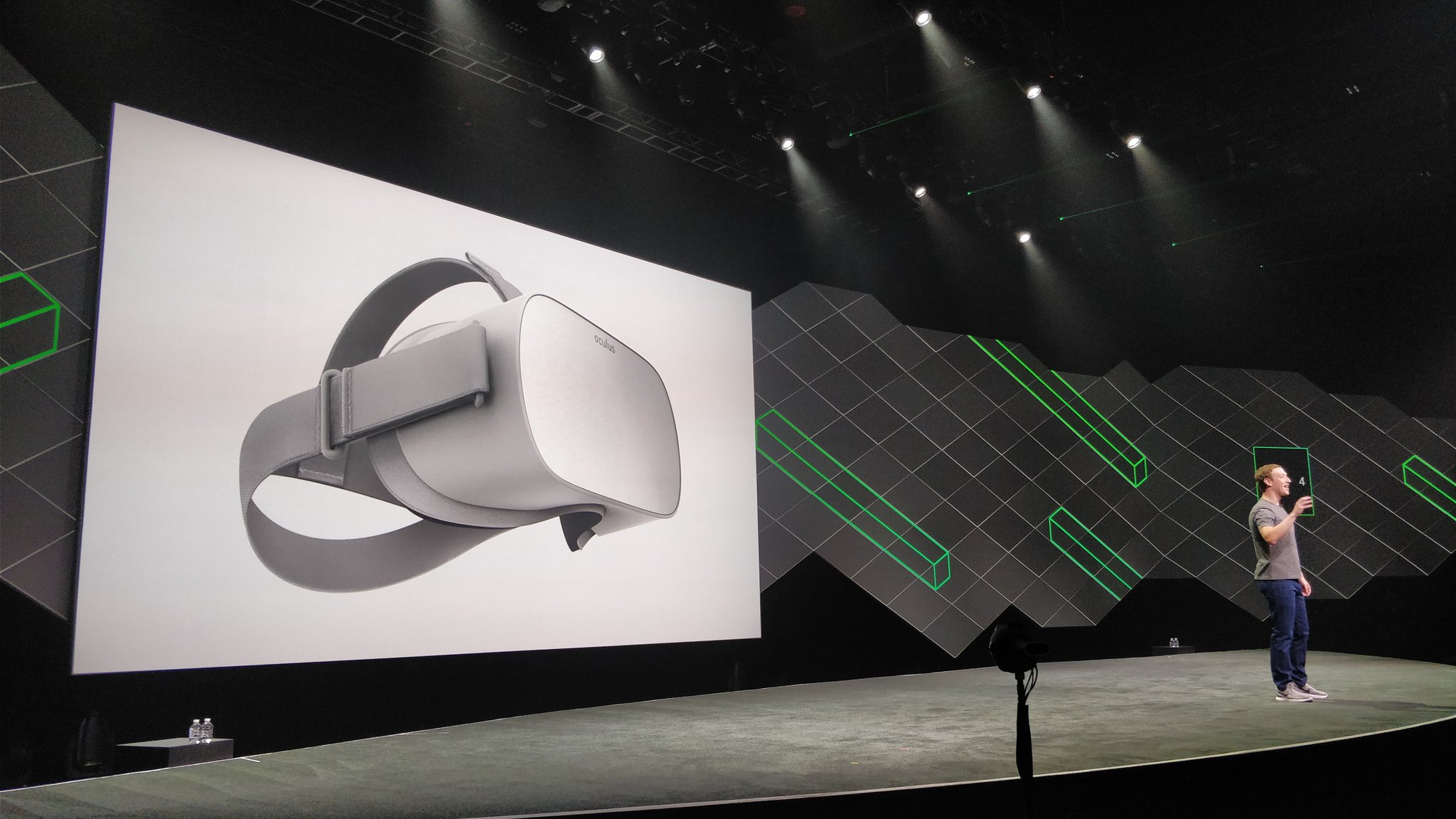

The Oculus Go being announced at OC4 by Zuckerberg hisself.

By 'recent developments' I am referring to the fact that I finally caught the VR bug back in October, when the Oculus Go was announced during their OC4 event down in San Jose (it was San Jose, right?). Something just clicked, and I decided that I would acquire a Go as soon as humanly possible and make 2018 the year I dive into VR development after wrapping up PixelCNC. I am convinced that the lower price point and removal of the requirement for owning a high end smartphone, PC, or game console will prove to be fruitful for the VR industry as a whole. More people will suddenly find low-end VR affordable, which will result in many more people being exposed to at least some form of quality VR - and not some shoddy makeshift excuse for VR like Google Cardboard (at least when used with phones that have poor sensor quality or clogged up Android systems that imbue apps with unbearable motion-to-photon latencies). Only then will they know the reason VR is here to stay!


"First Contact", the Oculus Rift demo I tried at Best Buy.

After a few months of watching PC VR headsets dropping in price I decided that I didn't want to limit myself to 3DOF (three degress of freedom) or the little directional remote controller, and started looking at different headsets. Eventually I found myself at Best Buy and demoed "First Contact" on the Rift. What a far cry from the DK2 that I had tried at a friend's house a few years prior! The Touch controllers made a world of difference, being able to actually interact with a virtual scene a universe away with my own hands was unlike anything I had ever imagined.


You forget you're holding controllers, and feel like you're grabbing things.

While my wife was ordering a new PSU on New Egg I told her to go ahead and order a Rift as well. I've been a proud owner of the Rift for a month now and have already been integrating the Oculus PC SDK into Bitphoria. There has been a lot of work that needed to be done, especially due to the fact that the vast majority of a game in Bitphoria is described in external text files, I needed to introduce some means for connecting entities to the controllers and responding to different input states with the buttons and thumbsticks.


This is what scripting simple VR player flying controls to Bitphoria looks like.

There's still a bit of work to go before it's fully integrated, at which point I can release Bitphoria as a means for people to quickly and easily script all manner of multiplayer games without having any real gamedev or modding experience. Ultimately I'd like to expand on the existing game bitfile system and circumvent the scripting system altogether by crafting a WYSIWIG game editor, which allows users to craft games directly in VR. Bitphoria would then be the first VR-based game making system! No more screwing around with Unity or Unreal, just fire up Bitphoria and start building games.


Even if you already know everything, you have to learn how *they* do it!

However, Bitphoria's codebase has begun showing its age already. The things that I wish I could've done differently are piling up, and make it difficult to work inside of. So, the plan for now is to just focus on making a single cool game out of Bitphoria, while promoting the scripting side of things to get people interested and involved in being able to make their own VR games with it. Ultimately, though, I plan to rebuild the engine from scratch - borrowing a lot of code and engine structure from the existing engine, but re-implementing everything more cleanly and with in-engine game editing in mind.

There are several components that would require specially designed and implemented WYSIWIG interfaces for crafting Bitphoria games:

  1. Entity Types - Describes each possible entity type, serving as a sort of template. Dictates the various aspects pertaining to a game entity, such as what physics behaviors they have, what effects flags they have set, their collision volume and its size, what entity functions various logic states can trigger, any ambient/looping audio, particle emissions, appearance, etc..
  2. Entity Functions - These are executable lists of instructions that produce specific entity behaviors as a result of different internal and external logic states or triggers that the engine detects through physics, player interaction, scripted timers and conditional statements becoming satisfied, and the like.
  3. Model Procedures - Lists of modeling operations which produce geometry for entity appearances by plotting out points, lines, triangles, and signed-distance function primitives for modeling voxel-based geometries with constructive solid geometry conventions. These can be made to vary in a number of ways with each generated instance of a procedure, allowing entities to not appear exactly identical to others of the same type.
  4. Dynamic Meshes - 3D point clouds of 'nodes' attached together using springs. Springs can be assigned procedural models to give the 'dynamesh' visual form and the appearance of multiple conjoined moving parts. Dynameshes allow entities to appear to have more dynamic physics interactions with the environment and other entities as well as allow for simple/crude animations. Otherwise entities would be restricted to appearing only as rigid static geometry.
  5. Entity HUD Overlays - Procedural models assigned to entity types to display various stats and visual indicators conveying the state of the entity. Entity state and properties can drive modifiers to animate color, orientation, size, and position of the models drawn to allow for a variety of interesting HUD elements (aka 'widgets') to be drawn over an entity in a player's perspective.
  6. World Prefabs - A more recent idea that I'm still toying with: world prefabs would consist of simple voxel models which the world-generation algorithm randomly places around the map per various modifier flags and statistical 'tendencies' specified for each prefab, providing some semblance of structure and design to worlds beyond what little is offered by the existing random plateaus/caves/pits. These could also have entity spawns placed in them so they can serve an actual function during gameplay.
Designing and implementing intuitive interfaces for users to define Bitphoria games with with - and have immediate feedback for quick iteration/turnaround time - that's a task unto itself. VR is a young medium that we're still becoming familiar with, and exploring the language of, so there's the added challenge of discovering what even works and what doesn't. I imagine that VR would allow for much more intuitive interfaces than 2D does, especially when it comes to crafting 3D content. We're still figuring it all out, all developers are, collectively. It's a bit of a wild-west.

Regardless, I believe it will be a powerful thing giving the average person the ability to easily create their own gaming experiences for VR with the right tools to enable them to quickly and easily produce quality interactive gaming experiences. Bitphoria's scripting system is designed to really reduce each possible dimension of a game to just a few simple options, but the number of dimensions and the freedom to connect up all sorts of pieces together is what allows for such a vast universe of permutations.

Ultimately, the goal has always been to create a system somewhat akin to Snapmap for DOOM, which coincidentally follows in the same vein as my original vision for Bitphoria - a platform for people to easily create and share their own mods/games. Snapmap's idea of a WYSIWIG editor trumps my weary plan for users to work in (relatively) tedious script files. Admittedly I was somewhat awe-struck and simultaneously irked when id Software unveiled DOOM at E3 2015, after I had already been working on Bitphoria for a year. "They stole my idea!"  I'm just glad Snapmap was the last project on DOOM that Carmack worked on before his departure, as it was born of the community modding spirit which he was always such a proponent of.


Editing some logic gates in DOOM's Snapmap.


Anyway, that's pretty much that. There's also a bunch of things I need to revisit, such as the post processing effects system, and the windmapping stuff, as these really sopped up any remaining CPU and GPU that was previously left on the table. In the case of running in VR, however, they seem to push the envelope a bit too far to be viable - at least on my bare-minimum VR spec system. I'll have to buckle down and really push to keep certain things in there. Screenspace reflections? Likely out of the question now, but maybe I can hack something to work that provides a similar effect. It was always more of an aesthetic thing than an aspect to make Bitphoria have more visual realism. Particles and wind fluid dynamics perhaps could be moved to the GPU, but we'll see. They might just be effects reserved for the highest of system specs.

I should be able to re-engage at least some minimal post processing effects. My FXAA implementation was pretty solid, and surely would be faster than supersampling, and possibly faster than multisampling. I'll just have to see for myself. The postfx system also was responsible for final color adjustment, and also featured a really cool spectral tracer effect which particles and entities could leave overbright residual trails across. It was subtle, but it really accentuated the whole aesthetic and feel, making certain objects seem like they were really glowing blindingly bright, such as lasers and explosions. The windmapping really lent itself to the overall feel as well. Maybe I can figure out some kind of layered screenspace/frustumspace fluid dynamics solver, which would project onto the scene when particles and entities query the windmap. It was always purely a visual effect that wasn't intended to be used to actually affect gameplay-relevant entities, and it really gave a whole new dimension to the feel of Bitphoria. I miss my wind.


Conclusion:

Now I have a customer base with PixelCNC, customers who invested in it as early-access software with the promise of new features coming down the pipe. I owe it to them for their support to continue staying focused, and productive, on PixelCNC. As far as I am concerned, any supporters who put a financial investment in something should take precedence over anything else I may have going on.


1.24.2018

PixelCNC: Images to CNC G-Code


Sometime early last year I'd finally won my wife over with the idea of making and selling various CNC milled/routed items on our Etsy store - where we've been selling crafts and prints for years. She's developed her own process for creating designs which I would then run through my process to produce a final product on my tabletop CNC.


However, this process was somewhat cumbersome and tedious, involving meshing the image using Blender (which could take a while when applying a decimate operation to get the polycount down to something workable) and then fiddling around in a conventional CAM program to actually generate toolpaths. The whole process was a very tweaking-intensive operation, requiring constant refinement and adjustment, which consumed more time than I thought should've been necessary. Isn't there a way I can just get from an image to G-code?

To improve the process I (apparently) wrote a program, 'TGA2STL' (https://github.com/DEF7/TGA2STL), early 2016, before I had convinced my lady of the profitable nature of the CNC - which was mostly sitting idle while I worked on my game engine Bitphoria. I had completely forgotten about TGA2STL until I stumbled across it in my projects folder a few months ago. I was surprised at both my thoroughness when developing it, and total forgetfulness at the fact I had created it at all. At any rate, it became a part of my new process for converting my wife's designs into finished products. But I was still left at the mercy of whatever toolpath generation software I had at my disposal: however tedious or uninspired they may be. I knew I could do better!

A project my father had always encouraged me to work on was a CAD/CAM package to undercut the professional packages that cost thousands of dollars, and that 90% of job shops only use 10% of the functionality from. My dad's big idea was for me to write a CAD/CAM program that only featured that 10% of functionality for all those shops, and sell it to them for the low price of $500. It was a project that always interested me from an algorithmic engineering standpoint, though it was never enough for me to drop existing projects to work on it.

Now, my father's original idea was a professional CAD/CAM program that could be used for precision machining and as awesome as that sounds I don't have a professional CNC, and I've also ventured into CNC on my own from more of a creative/hobby/artistry angle. I don't really have a personal use for a professional CAD/CAM program that I'd be making myself - aside from selling it for money. In spite of these sorts of projects being a bit of an arcane art form that I *could* spend years on, easily, I'd rather not. This is especially the case considering how many subscription pro-level CAM packages that exist nowadays, it would ultimately exist as just a mental masturbation project of sorts. Alternatively, I do have a use for a program that can take my wife's designs and turn them into G-code on the fly. In other words, I do have a use for a sort of hybrid project that merges my dad's idea for a bare-minimum CAM program and the workflow my wife and I would prefer to use, in terms of our CNC endeavors.


Enter PixelCNC...

I've been working on PixelCNC since the end of last summer, and it's finally released. You can check it out at http://deftware.itch.io/PixelCNC/ It's available as an early-access program, selling for $55.00, but there's a free trial version that can do all the same stuff, except for load images with > 65k pixels and load/save project files. Hopefully that's enough to get people hooked on it without giving it away for free.


PixelCNC generating a 'horizontal milling' operation.


7.05.2017

Long See no Time


It's been 5-months since my last blog post! In all actuality I simply burned out there for a while. I did manage to finally upgrade my CPU from a dual-core to a quad-core, allowing much better testing and enhancement of Bitphoria's multi-threading system. Many things have been added to Bitphoria since my last blog post.

I finally decided to add in a world-wide fluid dynamics simulation system with LOD to minimize computation. This effectively serves as a sort of 'windmap' for the world - and allows objects to either drag the 'air' around, pulling other objects, dynamic meshes, and particles around. Entities can also cause a momentary change in pressure at their location, for blast or black-hole vortex style effects that actually affect smoke and entities surrounding them. Rockets can now leave swirling trails of smoke, and cause particles to wisp around as they zoom through a cloud of them. It's pretty neato, but purely a superficial effect. It's something I've wanted to implement into Bitphoria since I first sat down and sketched out some ideas I wanted to see before I even started writing the engine.


I've also added signed distance function primitives to the procedural modeling stuff for easily constructing polygonal, wireframe, and point cloud geometries for entities - CSG style. This has made it much easier to model more interesting entity appearances, and now scripters aren't forced to plot individual vertices to create triangles.

Instead of explaining it much further I'll just show you a bunch of development screenshots from when I was working on the SDF modeling stuffs:

When things were first starting to work: plotting points for individual SDF voxels - sized according to the 'density' of the voxel they represent.

Generating a point-cloud only on the surface where the voxels are zero distance from the surface of the final distance field as produced from a cube added, a ring of spheres subtracted, and a single green sphere added to the top.

Utilizing the same voxel triangulation code to yield triangle mesh geometry from a SDF model.

In my attempt to add the ability to smooth an isomesh per the distance field, a lot of things were going wrong (these are supposed to just be smooth spheres).

A sphere that hasn't been smoothed, showing the base isomesh.

Some different tests: a smoothed cone (with crooked tip, this has since been fixed), a purple sphere with a pink capsule merged/added to it, as well as a green sphere with an orange capsule 'blended' into it (note the smooth transition between surfaces) while also being smoothed properly. You can smoothly blend/merge primitives while still producing a coarse isomesh with 45 degree angles.

A ring of spheres blend-merged and the result smoothed over.

Testing a different player appearance, using various things, while having the shield powerup - a set of overlapping point cloud spheres that all spin independently by rolling around against the surrounding world surfaces while the player moves.

A screenshot of the last of the testing/development game before I started scripting a new base game from scratch.

A bunch of other things have been added to Bitphoria as well, but I haven't touched it in at least 2 months and it's currently not something I'm particularly motivated to pursue. After making all the progress that I did on Bitphoria a few months ago I began scripting a base/default game that I would then use as a template for creating various game modes to release with the next version.

The base game is a sort of deathmatch game with simple AI drones and obstacles and hazards for players to negotiate while battling it out with one-another, which always seemed more interesting to me than just raw PvP deathmatch gameplay. Anyway, I just didn't find working on it rewarding anymore. I can come up with hundreds of little ideas and mechanics, knowing how to go about implementing them by exploiting the capabilities of Bitphoria's scripting system, but it just doesn't excite me like it did when I was younger. Back then I was working with the Quake engine. I'm sure scripting stuff in Bitphoria would be a blast for many other young spry minds out there, but I'm not of a mind to seek those kids out, even though they were what I was thinking of when I designed the whole thing.


Showing the effectiveness of Bitphoria's new FXAA post-processing shader at smoothing out super-jaggy aliasing on stair-step edge pixels. One of the many new things added to Bitphoria over the last while.

My goal has always been to make enough interesting stuff to show off Bitphoria's capabilities as a platform for creating, sharing, and playing custom games with other people - and hopefully have it be inspiring enough to motivate people to engage their own creative minds within the paradigm Bitphoria's scripting system provides. Well, as it stands, this probably won't be happening any time soon. I've had to make my peace with this fact over the last few months. I've been struggling to allow myself to work on anything else or pursue any of my other passions, not berating myself for letting Bitphoria development go idle. My resolve has been to look at this situation knowing that I owe it to myself to do what I must to take care of my own mental well-being and *let myself* pursue other projects and passions because nothing good comes about from sitting around not working on anything else purely out of guilt.

Yes, I wish that I could knock out Bitphoria in "record-manic-stay-up-all-night-not-caring-about-anything-else-in-life" time, which was naively my plan from the beginning, but it's just not in the stars. Am I lazy? Eh.. But if that were the case I don't think that I'd be feeling like there's not enough time in the day to work on what I *do* want to work on, especially after having overcome the self-inflicted shame I'd been enduring. I was tempted to release Bitphoria completely FOSS, just dump the code on the interwebs, and abandon any and all aspirations of trying to monetize it. I'd just be giving all of my work away for free. Alas, me lady talked me out of it, and explained that I should just let it sit until I was ready to come back to it. So that's what the plan is.


Bitphoria in its current form.

I've always been excellent at arcane technical pursuits and hacking away at them into the night, even now at thirty years old. But as far as actually designing a fun game or dealing with PR and promotion are concerned I am seriously lacking in drive and/or spirit. With recent developments I've become more inclined to focus on keeping my creative spirits high and working on what I love to work on: tackling difficult algorithmic problems. I've pretty much resigned to being the Wozniak to someone else's Jobs. I haven't met my 'Jobs' yet, and I hope I do someday, because I think that I have a lot to offer to and share with the world, and lack the ability to really get it out there.


The good old days.

In my relative slump I did manage to muster the gumption to start playing around on my CNC once again - the product of yet another 'abandoned' project that I had begun feeling guilty about for allowing to sit untouched and unloved for so long. It's really nice to have something to work on with my hands though :D

I've since explored a few ideas and have somehow finally convinced my wife that it's a financially worthwhile pursuit - making stuff on the CNC - which doesn't require dealing with nearly as many customers as our current crafting products do with our online business. We could be selling fewer big-ticket top-dollar high-end CNC-milled items rather than many cheaper smaller decorative items. In other words we could be making more money for less work, and deal with less customers, if we both transitioned our business toward producing large quality works as a team.

It would definitely be nice if we could spend more time together again like the old days, and I see CNC projects as being the nearest of several keys to unlocking that future for us, but it must be as a team. I don't believe she's the Jobs to my Woz, but I do believe we have the potential to achieve great things together. It has worked thus far with our online business, and I feel that she's fully capable of meeting me half-way while we engage a new medium together.

I've also been sketching out and outlining some ideas for an old project my late father had proposed and actively tried to encourage me to pursue. I'll save the details on that for a later blog post.


2.06.2017

Post-Processing Shaders and Effects


Bitphoria has had a simple post-processing effects setup in place for some time now. This comprised a single framebuffer object with a color and depth texture attached to it, which would be read by a single fragment shader on a full-screen quad in order to generate a simple mipmap blur and contrast boost. The aim here was to just achieve a very simple and basic effect beyond what simply rendering the scene straight to the screen/window could achieve. This could not perform multiple post processing passes or effects that required multiple shader stages.

I've always had the nagging sensation that something's visually missing from Bitphoria, beyond the general lack of coherent visuals - which I attribute to not having sat down and actually designed a cohesive appearance to a game via the engine's scripting functionality. With the ability to add various post processing effects to Bitphoria I feel that a more coherent visual aesthetic can be achieved beyond what one simple post processing shader offered.

For the new post processing effect system I wanted to be able to easily add more shaders, and route their inputs/outputs between them. At the beginning of each frame a 'raw framebuffer' is bound that has three texture attachments: RGBA color, XYZW reflection vectors, an HSL 'overbright' emission texture, and of course a depth texture. The reflection vectors texture is generated by all of the shaders used to render world geometry, procedural models, etc.. If a surface is not supposed to be reflective this is indicated by a reflection vector facing the viewpoint (Z = 0). The HSL overbright emission texture is for the 'spectral trails' shader effect, which creates a sort of quickly-fading 'rainbow' trail behind the objects that write to that texture when rendered.

Objects leaving spectral trails on the screen. This can be annoying and so has been toned down and is mostly used sparingly for momentary effects like explosions.

At the end of the frame the postfx system is executed, which then goes ahead and renders a fullscreen quad for each registered shader effect - binding all necessary textures and setting all prescribed GLSL uniforms for each.

Creating an effect stage involves loading its shader, creating an FBO, and attaching a single color texture to the FBO to be used as the effect's "output". A depth texture is also created and attached to the FBO only for what's called "FBO completeness", even though the full-screen quads do not convey any depth information. Still, a shader effect *could* generate depth values that would be written to the depth textures using gl_FragDepth, and that depth texture could be utilized by succeeding effect stages.

From there shader uniforms can be added from the engine with "pfx_parm()", where ints, floats, vec3s and mat4s (4x4 matrices) can have a pointer to their memory stored and used to set any necessary values the effect's shader may require.


Bitphoria's current postfx shader pipeline. Green boxes are texture outputs from effect shaders.


Similarly, "pfx_input()" is used for referencing other effects, allowing their FBO color or depth textures to be bound when the current effect is being rendered, for routing the output of stages as inputs into others. Some effect shaders will use the FBO texture output of previous stages (or the output of later stages from the previous frame) as inputs for certain effects.


1.22.2017

Todo List Prioritization, Screen Space Reflections, and a Long Break


 After Bitphoria's initial release, I spent a few weeks with those who participated in helping to test it out and discovered a few bugs and things that desperately needed changing/fixing/etc. I also started working on fleshing out the three default games that come with it. In doing so it became clear what other features the scripting system was lacking. As a result of the public beta release the todo list grew quickly. Even though I was knocking out new features and bug fixes in that first few weeks the list continued to grow faster than I could keep up.


Bitphoria's accumulated "changes.txt" since v1.0a release (formerly 'v1.00b').


 I'd since decided to take a break. It was a power burn-out session in the few months leading to the established release date that I aimed to meet. The break was meant to strengthen my resolve in finishing Bitphoria as a project. The end goal is to produce a product that could hopefully generate an extra income for my family, my wife and two baby girls. I owe it to them to see this thing through after subjecting them to all of the time I have spent working on it.

 The master server has been running this whole time, well, at least 95% of the time, and I see that people have been looking for online games (of which there are usually none) and then starting their own to check out Bitphoria. I'm not going to continue actively promoting Bitphoria until things are further along. If other people want to show Bitphoria to others and share it, I'm not going to stop them. My goal here is a sort of soft-launch, whereby people can start playing with Bitphoria while it's being developed, and the 'die-hard-core' fans are the ones who keep it alive and seed a community and fanbase. Sounds good on paper, we'll see how it all pans out in practice. In the meantime I'm sticking with incremental public alpha/beta releases on itch.io until the scripted games are all fleshed out and everything's at least had a once-over - at which point I think I'll invest in a Steam Greenlight strategy, or maybe even a crowd-funding campaign for a virtually finished game! (That *is* what it takes nowadays to crowdfund a game, right?) At any rate there's no point to an all-too-premature push for exposure, which just so happens to have backfired on many-a-indie game project due to negative exposure from the poor quality of an unfinished product. This can end in permanently tainting and marring a game's reputation regardless of how the finished product turns out down the road.

 At this point, having started diving back into Bitphoria's code and becoming reacquainted with the todo list and where things are at. It's become clear that there's still a long ways to go if I want this thing to be one-hundred percent uncompromising. However, I don't think I have it in me to pull that off. So, the next step was organizing the todo list by priority. What things are absolutely essential to the core idea of Bitphoria? What things can it go without? What things can I add in later that are aesthetic-only? What ideas are pipe-dreams? This is where the project is currently at. By my estimation Bitphoria should be on sale in the summer.


I forgot how awesome it was to upgrade. Been out of the hardware game for over a decade.

 The todo list is fully consolidated, after another sleepless night, and I have my work cut out for me. I also recently bought a GPU for myself for Christmas, a 4GB XFX Radeon RX 460. Literally the first GPU I have gone out of my way to acquire in 15+ years. Half the reason I bought it was to play DOOM. Incidentally, the last GPU I made it a point to acquire was a GeForce3, back in 2001, so that I'd be ready to play Doom3, which ended up not being released for 3 more years. The new GPU has afforded me the opportunity to get crazy with Bitphoria's graphics, and makes it possible to record at least 720p gameplay footage at 30fps. The original plan wtih Bitphoria was to design a cool looking game/engine that would run on older and/or budget hardware at playable speeds - where 'playable' in my gamer opinion is 60+ frames per second, minimum.


Now for a blurring post-process shader to hide the jitter-induced dithering!

 I just finished implementing a decent screen-space reflection shader, written by hand from scratch, based on my own ideas about how to get the information where it needs to be in order to make it happen. Instead of having multiple FBO textures storing surface normal, surface position, etc.. I am actually only storing the vertex-shader calculated reflection normal that is interpolated by the fragment shader of reflective surfaces. This is in contrast with how most implementations calculate the reflection normal in the fragment shader using the fragment's normalized camera-space coordinate and normal of the fragment - both output by the reflecting surface's shader into (typically) different FBO textures.


Camera-space reflection vector, depicted as RGB representing XYZ -1/1.

 In Bitphoria, my idea was to pre-calculate the reflection vector in the vertex shader to be interpolated across surface triangles, and then pack it into the red-green channels of a single RGBA texture from the fragment shader using a spheremap transform, which is much more compact than packing both a coordinate *and* surface normal to accomplish the same result. However, I still need the coordinate of the fragment to perform the actual raytrace, which happens to be reconstituted from the fragment's W coordinate, stored in the alpha channel of the same texture. With both the W coordinate and depth buffer texture, as well as the pre-calculated inverse of the projection matrix that's used to render the scene, I can very cheaply calculate the camera-space coordinate of the fragment.


3D texture materials give surfaces a parallax depth to them unlike anything you've seen in a game.

 I also gave the sky shader a much needed re-design, along with tweaking the 3D material rendering shader to literally shade the depths of the procedural 3D materials. The 3d material shading method would have naively been implemented by sampling a 2x2x2 area and gauging the overall density gradient normal. The dot product of that normal and the incoming light vector would be used to determine the brightness of that point in the material during rendering. However, as Inigo Quilez explains in one of his articles (link below), you only really need two samples of the 3D volume - along the incident light vector itself.


The sky is like techno water, slowly drifting and undulating like pool water caustics.

 Even with a new GPU there's room for optimization, and the plan now is to refactor the ultra-basic post-processing system I wrote a while back to perform a basic Bloom glow shader, and properly integrate everything. The sky is procedurally generated by its own fragment shader, and could stand to be downscaled by a factor of two, or possibly four, and rendered to a texture that is then upscaled to the full view size. This is also the plan for the screenspace reflections which are ironically slower with a higher jitter factor that is used to disguise the banding artifacts by introducing a sort of dither. It's almost faster to just have a smaller raytrace step increment than it is to have a larger one and hide the banding with the jitter. It's quite possible that this is specific to my GPU. In either case, some kind of antialiasing/blur post processing shader is in order.

 Another thing I am exploring is the generation and use of a max-z quad-tree where the depth buffer is successively reduced into higher and higher mipmap levels that represent the nearest-most point. Raytracing then occurs through the resulting quad-tree. But, resorting to simply rendering SSRs at 1/4 the area of the full-resolution screen seems like it will speed things up to where the construction of a depth-buffer quad-tree would be slower - unless I were to utilize it for more than just SSRs (screen

 A few other things on the todo list are team-assigned 3D materials, whereby different areas of the world can have different 3D texture materials ascribed to them so as to more clearly depict team territories. Alongside that I am toying with the idea of allowing game server admins to also choose different procedural algorithms for each team, so that different teams' areas of the world can be dramatically contrasting with one-another. At the very least I aim to allow server admins to choose from different world-generation algorithms that would dictate what the entire world would be like.


More visitors coming from www.itch.io itself lately, as opposed to old Reddit/Gamedev posts.

 Anyway, I noticed that I've been getting a trickle of Twitter followers, when I normally never even look at Twitter, so I've begun tweeting more. I also noticed that on itch.io both my developer page that shows my three projects on there, including Bitphoria page, are getting more traffic from itch.io itself - whereas in the past the traffic came almost entirely from Reddit posts and gamedev forums where I shared a link to it. It would seem that Bitphoria has reached some kind of low-level critical mass for it to now be more prominent in search results. So that's neato.


Links:


9.02.2016

v1.00 Public Beta Testing


The biggest Bitphoria game in history.

Looks like some people have started taking interest in Bitphoria. There are a lot of kinks to work out, some people are having issues starting a game and having their friends join. I'm looking into it. Lots of little things are being figured out: players can be hard to see, chat messages disappear too quickly, the server I'm running crashed in the middle of the night while two people were playing, AI guys are more aggressive than they need to be, etc.

The end result is inevitably a new release, v1.01, which will have a new network protocol version. The master server will only relay game servers to your version of Bitphoria that are running with the same network protocol. I will be updating my game server to v1.01 when it's released, so people who are still playing with v1.00 will not be able to see it or play on it. An auto-update feature will be implemented down the road, for now my focus is on the engine.

It was also suggested that an automated installer would make it easier for some people to start playing Bitphoria. I already have a process in place for achieving this and wasn't planning on utilizing it until Bitphoria was out of beta, but I have decided to include an automated installer with the next release.

I estimate v1.01 to be released some time next week, maybe sooner.

Thanks to everybody who downloaded the current version and has been playing with it. This has been more fun that I could have imagined :)

8.30.2016

Bitphoria v1.00 Beta Released

Pre-release early screenshot of Bitphoria.
Bitphoria has been released. It's in public beta, and this is the very first (aka 'worst') version ever. Start games (don't forget to forward your UDP port if behind a router) and play with others. Dive into the scripting system and make whatever your heart desires. Let's see what Bitphoria can do.

An engine guide is in the works now, to help users better understand the various console variables and how to make full use of them as a sort of 'power user'. I'm sure anybody with their wits about them could figure out most of them just by surfing the console typing a few characters and pressing 'tab'. The confusion, by comparison to most engines with a console, will lie in the fact that the vast majority of console commands are for scripting, and not intended to be executed while in a game, or while just idling in the main menu system.

If you're the type of person who likes to get into new things, unafraid, and share your findings with others, then by all means download Bitphoria, start screwing around, and Youtube your experiences. Share this thing with the world. If you could notify me of your intentions to release a video of your time with Bitphoria that would be great, just so I could follow along and gain some insight as to what I should work on or do differently.


8.29.2016

Final Day Thoughts


I started Bitphoria in April of 2014, focusing solely on how the world was generated, represented, rendered, etc.. I had a pretty clear vision of what I wanted the engine to be capable of, and I feel I have achieved that.

Yesterday I finally reached the 20k lines of actual code that I predicted Bitphoria would have by its release date. The scripting manual for making games out of Bitphoria is complete. I'll be uploading the game tonight for release. It's a public beta version that has all of the features I wanted but are not fully polished and probably have some bugs. The goal is to see what kind of feedback comes from releasing it in the state it is in. I haven't been actively promoting Bitphoria very much at all, and figure that if it's any good it will sell itself by spreading via word of mouth. People will post screenshots, youtubes, start making games, playing against eachother online, etc..

Only time will tell.


Bitphoria's source code folder, comprised of 20k actual lines of code.


Tomorrow I will be sharing its release on Reddit and other various online communities, so we'll see what sort of response develops. This blog itself has just been a place for me to share my thoughts, and it does get a few dozen hits a day now, but nothing I would consider a great internet success, not by a long shot. I hope some people have found enjoyment and value in my blog, and perhaps if more people knew about it there would be more people that did find value in it.


I developed Bitphoria on my own time, while being a full-time stay-at-home Dad and running an Etsy business with my wife Heidi. It's a project I've always wanted to do, that I've attempted many times for the past 20 years, and life always seemed to get in the way. It was a matter of time before I finally made something.

Bitphoria's future is in the hands of the people after today. Once it's out there I'll probably stop working on it altogether unless it starts developing some kind of following or fanbase and I begin receiving feedback. At this point, it will serve as a great portfolio piece that demonstrates how well-rehearsed I am with all aspects of game development, from graphics programming, to networking programming, procedural techniques, and everything else in-between. This is just what I could do by myself in a limited amount of time, and I could do a lot, because I always dreamed to.

Bitphoria avoids issues like asset management and art pipelines, because I didn't plan on having artists, I planned on the players being the artists, almost in the same way that Quake and Half-Life were made popular by Team Fortress and Counter-Strike respectively. It wasn't the base game that made the game famous so much as it was the creativity of the masses. I'm counting on this, somewhat, with Bitphoria, and the fact that people like to make stuff. Bitphoria is meant to serve as a platform for people to create and share their creations, by abstracting things in a highly simple fashion that is easily accessible through a simple script-based construct.


Bitphoria's initialization function.


My goal was to have three separate games for players to play that were somewhat fleshed out. I will probably flesh them out in time, but I spent more time in the engine code than I had thought I would, so this first release will only really feature the deathmatch game, and the two barely-started CTF and instakill games that are far from complete. Fortunately every functionality of the scripting system is utilized by these games, for I had to test each one while developing it, so they appear somewhere in at least one of the three games' scripts. Hopefully this, in combination with the scripting manual I toiled to produce, will allow someone to start making something more inspired than the default games. The capabilities required to make a great game is there, that's a promise.

The master server will be running once I upload and link the release. I haven't fully tested it yet, so if you're one of the first people to download and playtest with a friend, please let me know if you encounter any issues immediately, so I can rectify them as quickly as possible and get something that people can fully dive into without having to worry about being able to connect with other players.

This is going to be a sort of Wild-West time if Bitphoria picks up and people start taking interest. There will probably be bugs and simple tricks to take advantage of the game, perhaps malicious server-crashing bugs, etc. that will be discovered and exploited. If these are found I will solve them just like everything else throughout the game's development, and they will only be found if people are actively trying to enjoy it. If people want more from Bitphoria, I will work to provide it, and it will be a process but we can get it there. I've been developing Bitphoria in a virtual vacuum, without much outside influence or suggestion, aside from the few comments coming from my long-time friend Paul Hindt. Other than that, this is the first time Bitphoria will see the light of day. This is going to be the worst Bitphoria release yet, and better ones are to come if enough people are interested.

If the game is DOA and nobody takes interest, I will eventually release the engine's source code as well, because I feel it is important for people to have resources to gain inspiration, insight, and ideas from. I took a lot of inspiration from the Quake engine, and the original Cube engine, insofar as some of the conventions for game logic are concerned.

Following in the same vein, Linux and MacOS ports will not be hard to produce being that the game runs almost entirely ontop of SDL2, but I don't plan on doing the necessary steps to releasing ports unless a demand arises. The only platform-specific code involved in the engine, as a matter of fact, is the code that lists all of the games in the games folder. There is no platform-independent method for listing the files in a directory so I wrote a simple command-line that performs a 'dir' command and dumps the result into a temp file that is loaded and the names of the game files are then extracted from. Other than that everything is occurring through SDL, so it shouldn't take very much time to compile ports.

All-in-all this release could have happened sooner, but I didn't want to have an Alpha release that lacked many features from the final product. At least at this point they are present and accounted for. There are maybe two or three little things I'd still like to add in, but at this point the project needs to get into the hands of the public so we can see what happens with it and where it should go next, if it is something that's bound to go anywhere at all.

Ultimately, if Bitphoria becomes somewhat popular, I will be pushing for actually selling it. To mitigate piracy I will be selling online player accounts, following the Minecraft model, which will integrate with the master server and be required in order to play on servers that are listed on the master server. That's down the road, but is solidly the plan if, again, people show interest.

8.02.2016

Bitphoria's Release Date Announcement


 I have decided to make my 30th birthday the release date for Bitphoria, which happens to be August 30th 2016. There are several things I'd like to finish, among bug-fixes and networking improvements, before the first release and I thought I'd share that list here. Whatever state Bitphoria is in on that day it will be released.

It is obviously crunch time now (a great motivator for me) so the things on my list that I'd like to have done might be cut short, but I will continue working on it well into the future beyond the release. This will manifest itself in the form of new and updated releases. The initial release itself is meant to serve further development of Bitphoria by allowing other people to finally start messing around, playing games, scripting games, and providing me with bugs and feedback about everything.

I plan on releasing Bitphoria as a sort of public beta, for people to get to know it and see what I've dumped almost two years of my life into. Maybe down the road I will sell it for a few bucks on Steam/Itch.io. Maybe I should crowdfund polishing it, because I clearly have something that's worth something to someone, somewhere, out there, and I think it has a chance at being a crowdfunding success (after all the hard work is done already).

Hardware contributions/donations are always welcome! ;) I'm currently developing Bitphoria on four different machines: two low-end laptops from a few years ago, a low-end pre-built HP desktop from the same time, and a custom-built desktop - all with integrated graphics. I did manage to borrow an nVidia GTX 680 in the custom-built desktop system that allowed me to record some footage of Bitphoria earlier on, but have since been without and could definitely use a decent GPU just for the sake of tuning Bitphoria's graphics to where high-end systems can be fully taken advantage of for hardcore PC gamers, as well as allowing me to record updated videos of what Bitphoria looks and behaves like. Recording video is actually my primary goal insofar as GPU acquisition is concerned, because without it I will have a harder time demonstrating the game. Worst-case scenario hopefully fans out there will take it upon themselves to youtube videos of Bitphoria. If nobody does that then I've failed at making something that sells itself, obviously, and that's the goal of any project of mine!

If the case is that nobody ever cares about Bitphoria, and it just gathers cobwebs and dust in a dark corner of the web (on this blog, and in a few reddit posts), never amounting to anything more than just a "portfolio piece" for me to acquire a dead-end soul-crushing software engineer job, then at that point I will just release the code in its entirety for everyone to tinker with and learn from. At any rate, the code will ultimately be released eventually. The 'when' of that is still up in the air, and probably will be for at least another year. But if I can earn a living for my family via my lifetime hobby then I'm certainly going to try before giving it all away. Over two decades of programming experience has gone into this project, and there are even things that I learned along the way while developing it that I'd like to invest into a new game engine project, but those are things that I'm just going to hang onto until I feel that this project is 'done', through-and-through, which includes promoting it to a respectable degree that hopefully provides it with enough exposure to ascertain as to whether or not it is something that there is interest in.

As far as my pre-release todo-list is concerned I believe that setting up a master server for people to find each-others' games is imperative, otherwise the whole project is pretty pointless if people can only start a game server, run around by themselves, and then quit out and never play it again. Scripting features and functionality seem less consequential and could be added in along the way at a later time after the initial release, but the existing setup is rather competent. Finishing the scripting documentation also remains a top-priority issue due to the fact that I wish for people to be able to start playing around with the engine itself to see what they can come up with within the creative sandbox that it represents. It has its quirks and nuanced requirements insofar as game performance are concerned (graphically, physics-wise, and networking) which is the case with any game engine out there. However, I would like to point out that it takes no game-development know-how or modding experience to make something out of, or with Bitphoria. Anybody should be able to simply open up the script files that comprise the default games included with Bitphoria and start surfing the documentation to figure out how it all comes together.

Here's my list of things left to do for Bitphoria before releasing it that I'm currently focusing on for the next few weeks:


Master Server: Write and launch a master server to run here from my home to allow players to be able to start and find/join eachothers' games. Along with this I'd prefer to invest in a domain name that points to the master server (my house IP) for the in-game server browser to download the server list from. This would actually kill two birds with one stone. Firstly, it would eliminate the learning curve of PHP and MySQL that I'd need to traverse if I were to create an HTTP master server. I *do* have enough experience with both to make it happen but I'm not competent or well-rehearsed enough to simply knock it out within a day or two - and it would require that I implement HTTP request functionality into Bitphoria, be it by hand or integrating CURL/libCURL. Secondly, running a custom-coded master server from home would allow me to easily implement a NAT-punchthrough handshake protocol to allow anybody to start a game without being required to deal with their router/firewall and port-forward. Conversely, anyone else would also be able to join any game regardless of whether or not they themselves are also behind a router/firewall. This functionality requires that the master server notify game servers when someone is trying to join them, and from what IP/port, allowing the game server to go ahead and send a 'trailblazing' packet to the client player for the sake of tunneling through the NAT and have it route packets from that client player's address to the game server. To have a console application running in the background on my desktop, written in C, using winsock or SDL_net, that would be easy to manage would be much simpler and cheaper than any remote/online option I've come across so far. If at some point there's too much traffic for my home connection I'd then move the master server program to a dedicated virtual host and simply point the domain name at that, and everything will just continue working for everyone without any changes for end-users.


Network Buffering: Implement a network buffering system to, for one, allow for the simulation of latency and its fluctuation for testing/tuning purposes. So far I've only been able to generate repulsive/gross/erratic network behavior when my daughter watches Youtube/Netflix on her machine while I have two machines sharing a Bitphoria game over our wireless LAN. Also, in spite of my efforts to fight network update jitter using extrapolation when an update packet arrives later than intended, it would seem that Gaffer's strategy (gafferongames.com) of simply buffering network updates long enough to encompass most network jitter and then subsequently emitting them to the engine internals at the interval they were intended to arrive at would be vastly more effective in its precision and lack of interpolated correction. Buffering network packets as such would also allow me to simulate internet conditions locally without having to track down willing testers (I'm not really a 'people-person', and I have no more computer friends left) and fine-tune everything for what I like to think of as the 'fringe-market' - people who don't have high-end gaming systems (a netbook) or fiber-optic connections. I'm of the mind to release a game that looks prettier the better the setup, but also is completely performant on less ideal setups. Why focus on one area of the market if you can focus on the entire market?

Scripting System Documentation: Finish the scripting system documentation, which would include indications as to where inside of the the sample/default games that are packaged with the initial release that users can find examples of each script command, along with tips/tricks. Also, early on I made it a point to document everything that I script for Bitphoria because I know that people out there should be encouraged to tinker around and pull everything apart.

Artificial Intelligence: Add in simple AI functionality that allows an entity to seek out other entities and designate them as its target, which it can then follow or aim at. This would make it possible for simple zombie-type enemies that just follow players and harass them while they try to carry out other things. I'd like to include some kind of simple navmesh generation that is derived from the distance field of the world but I am thinking I am just going to literally index the distance field and use that for obstacle avoidance while entities try to pursue other ones. If a target is unreachable then it could back out following the distance field outward until the target is visible again, or a new target is found.

World Generation Modes: Add options for the style of the world generation itself. Right now it's a fixed algorithm and starting a game server entails selecting a random seed and then a vertical-scale which is forwarded to clients so they can then generate the same world themselves and play. The world is generated as a 128^3 volume and there's a lot more that could be done with it than just leaving one algorithm in there for people to experience.

Physics Attachment: Entity attachment which allows for an entity to literally attach itself to another entity and inherit its position/motion, with or without an offset that is oriented with the entity being attached to. This could be used for CTF games or power-up modes that want to display some kind of visible effect.


These are more-or-less listed in order of priority. What actually happens by the release date is still completely variable, these are just my intentions and goals, and it's hard to say what exactly will occur as I pursue each bullet point.

6.19.2016

Bitphoria Screenshots


 I just felt compelled to post some new screenshots. Not much has changed as I've been working on underlying stuffs and writing the scripting manual, but it sure looks purdy.


Check back soon for more updates. I'm in the midst of designing the master server situation so players can start and find one-anothers' games easily without any port-forwarding nonsense. I'm also hammering out the Bitphoria Scripting Manual as a guide and reference for people who want to make their own games out of Bitphoria and share them with the world via the ingame server-browser. Players do not have to download anything externally to play custom Bitphoria games. It's a thing of beauty.